Function calls
On this page we describe how an openOBD session can be used to run functions, and how function calls can be made. For a better understanding of the definition and use of an openOBD function, please read this page first.
Note
The states interrupted and failed are final states and do not allow any transitions anymore. They all
indicate the end of an openOBD session. Therefore, we can leave those two states out of the diagrams described on this page.
Default function context
An openOBD session in its most simple form has one default function context. By function context we mean a piece of memory that is managed by the openOBD session.
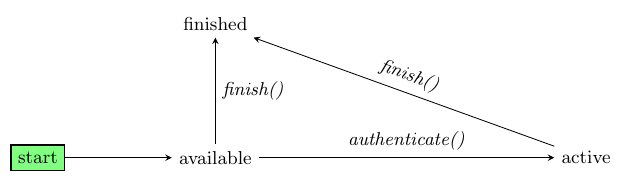
Context
It is possible to create new function contexts. An openOBD session can stack multiple function contexts, and every
function context follows the same state diagram with the two main operative states available and active.
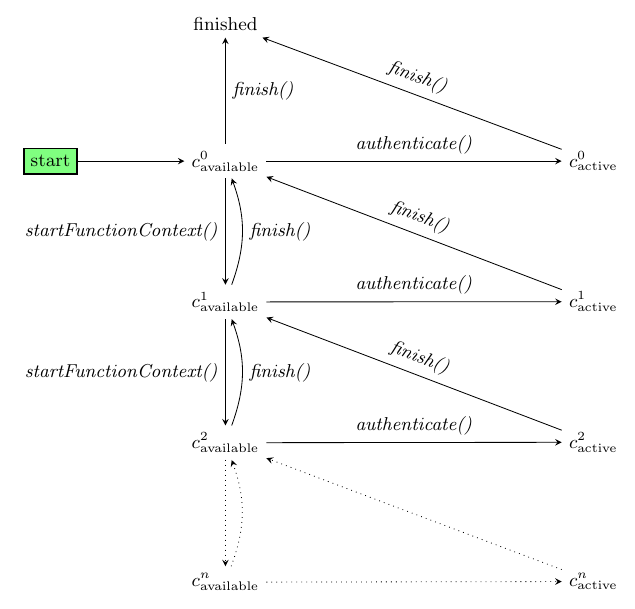
A new context \({c}^{n+1}\) can be started from the parent context \({c}^{n}\). If the parent context is in state active, the new context
will be a communication-only mode. This means that the new context cannot access the user interface, but can access other functionality.
If the parent context is in state available, the new context will have full access to all functionality.
gRPC function calls related to state
The following diagram shows which gRPC function calls are allowed in which state of the openOBD function context. It also indicates which function calls result in a state transition.
gRPC Call |
Allowed in state \({c}^{n}_{\text{available}}\) | Allowed in state \({c}^{n}_{\text{active}}\) | Remarks |
|---|---|---|---|
authenticate() |
yes | no | Transitions to state \({c}^{n}_{\text{active}}\) |
assertAuthenticationPossible() |
yes | yes | Asserts that authenticate() is allowed (without actually authenticating) |
openSessionTokenStream() |
no | yes | - |
getConfigurationList() |
no | yes | - |
finish() |
yes | yes | Transitions to state \(\begin{cases}{c}^{n-1}_{\text{available}} &\text{if } n > 0 \\\text{finished} &\text{if } n = 0\end{cases}\) |
startFunctionContext() |
yes | yes | Transitions to state \({c}^{n+1}_{\text{available}}\) |
monitorFunctionContext() |
yes | yes | When context \({c}^{n}\) finishes (finish() is being called), this stream returns a fresh authentication token for \({c}^{n-1}\), if that context is in AVAILABLE state. |
registerFunctionDetails() |
yes | yes | Store function information in context \({c}^{n}\) |
getFunctionDetails() |
yes | yes | - |
setFunctionArgument() |
yes | yes | Store arguments in context \({c}^{n}\) |
setFunctionResult() |
no | yes | Store results in context \({c}^{n-1}\) |
getVariableList() |
yes | yes | - |
setVariable() |
yes | yes | - |
getVariable() |
yes | yes | - |
deleteVariable() |
yes | yes | - |