Why "the coding of a car after a towbar retrofit" is the ultimate openOBD project?
The Netherlands has a peculiar love affair with mobile homes. This, combined with the increasing complexity of modern vehicles, has made towbar retrofits a lucrative but challenging business. Let's delve into why coding a car after such a retrofit is a prime example of openOBD's potential.
The Challenge of Modern Vehicle Complexity
Today’s cars, like the AUDI Q8 - E-TRON SUV (GEG) 55 quattro, are intricate systems with dozens of interconnected modules. While a towbar might seem like a simple addition, its installation often necessitates complex reconfigurations of the vehicle’s electronics. This requires specialized knowledge and tools, making it a time-consuming and error-prone task for workshop technicians. Recognizing the potential for automation in the automotive industry, our team of skilled developers Martijn, Sander, Jaro, Rohaan, and Floor, led by project owner Frank and guided by software architect Gerhard, embarked on a mission to streamline the complex process of towbar retrofits.
"We started with a relatively simple task, automating the Park Distance Control module, to get a feel for the project," says Rohaan. "It was a good starting point to understand the complexities involved."
Jaro adds, "Handling different vehicle variants was a significant challenge. We had to ensure our solution was flexible enough to adapt to various car models."
Martijn explains the importance of diagnostics: "Implementing pre- and post-scan diagnostics was crucial for identifying potential issues and ensuring the vehicle's functionality after the retrofit."
Sander focused on error handling: "By integrating common installation errors into our procedure, we empowered technicians to resolve problems independently, which significantly improved efficiency. A common mistake mechanics make is disconnecting the battery minus cable during the retrofit. This causes the steering angle sensor to lose initialization, leading to numerous fault and warning messages. Our procedure detects this issue and provides clear instructions to reinitialize the sensor"
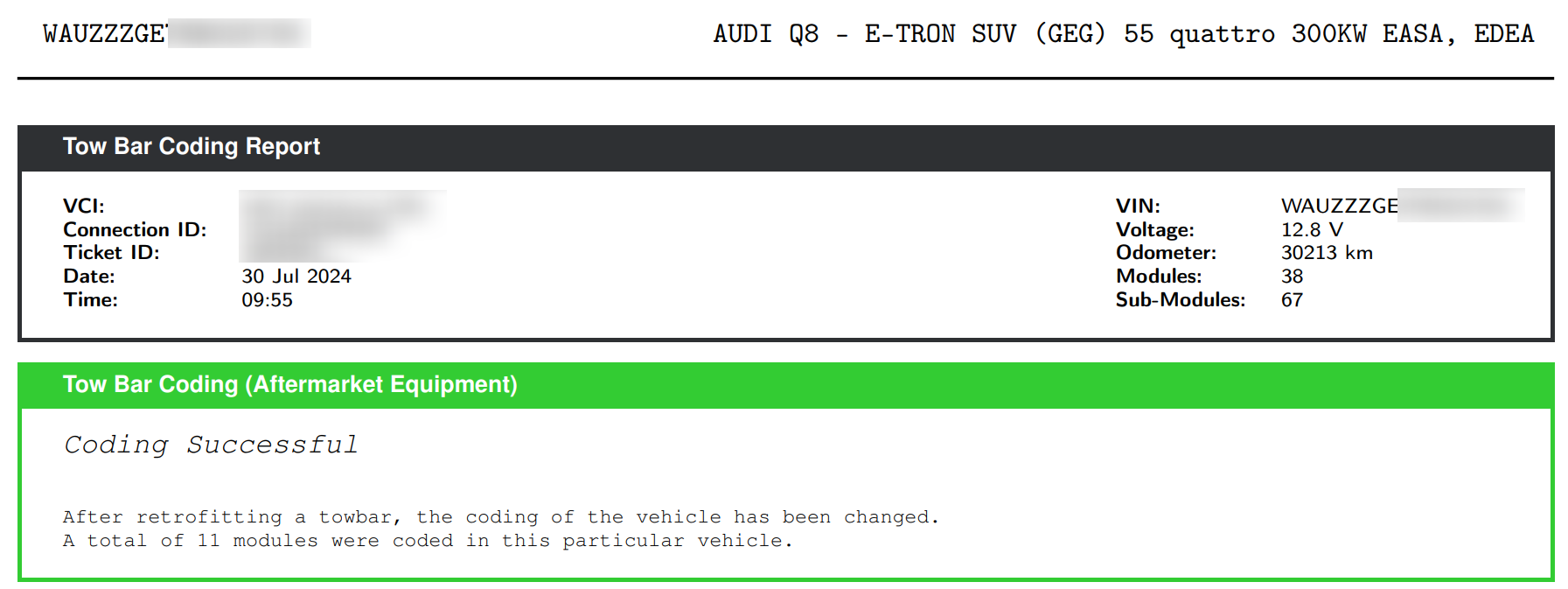
Floor, with a focus on the user experience, says, "Our solution can now code an entire AUDI Q8 - E-TRON SUV (GEG) 55 quattro in minutes. Generating a detailed report was essential for transparency and to provide valuable insights for both technicians and engineers."
The Power of openOBD
Gerhard, our software architect, emphasizes the role of openOBD in our success: "openOBD provided the perfect foundation for our project. Its flexibility and support for multiple programming languages allowed us to create a robust and efficient solution."
Frank, our project owner, adds: "The potential business impact is enormous. By automating this process, we're not only saving time and money for workshops, but we're also creating new opportunities for innovation and growth in the automotive aftermarket." By leveraging openOBD, businesses can position themselves as leaders in vehicle diagnostics and aftersales services. The potential for developing new and innovative diagnostic solutions is vast, opening up new revenue streams and market opportunities.
Let's Build the Future of Automotive Diagnostics
We’ve shown you how openOBD can be used to tackle a complex automotive challenge. Imagine what you could build! Ready to dive into the world of automotive diagnostics?